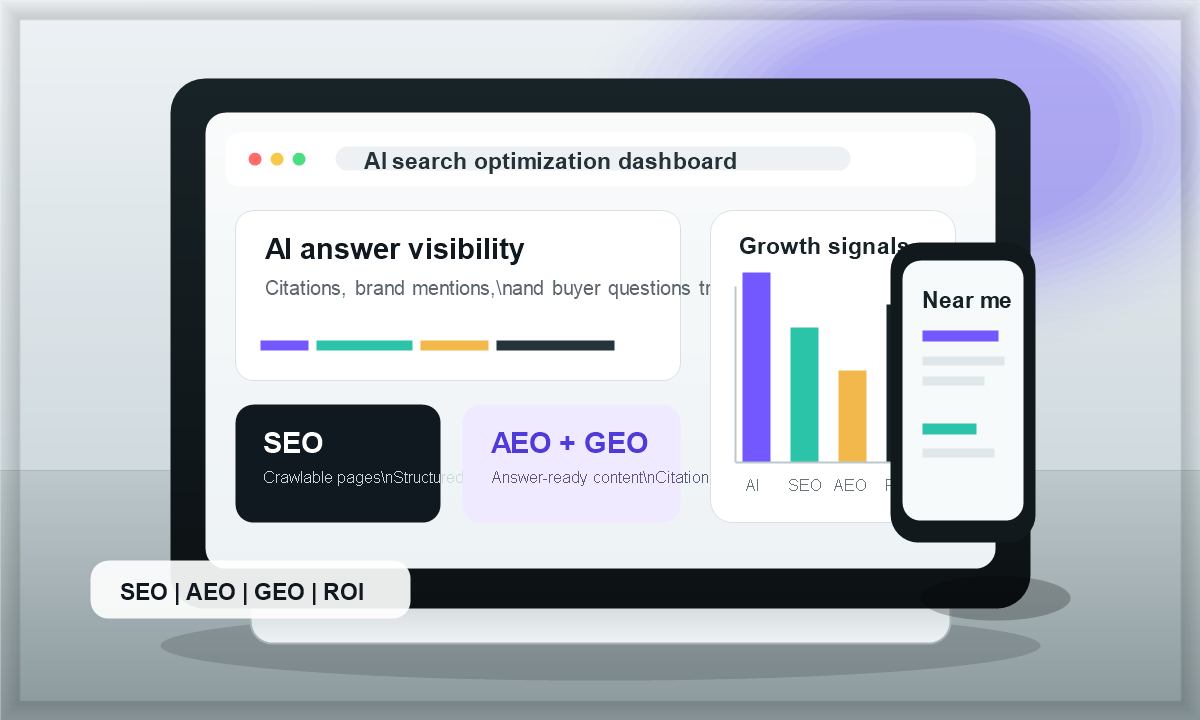
A strange thing is happening for many brands: rankings look okay, but website traffic feels thinner. The customer may still be searching, but the answer is now often shown before they click.
Primary keyword: AI search optimization
Search intent: founders and marketing teams comparing SEO, AEO, and GEO for measurable growth.
Key Takeaways
- Google says the same SEO fundamentals still apply to AI Overviews and AI Mode: indexable pages, helpful content, internal links, page experience, text content, and accurate structured data.
- AEO helps your brand answer specific buyer questions. GEO helps your brand get mentioned or cited by AI systems. Both need strong SEO foundations.
- AI visibility should be measured by citations, branded search lift, qualified traffic, assisted conversions, and CRM outcomes, not traffic alone.
Why Traffic Can Drop Even When SEO Is Not Dead
People often ask, "Is SEO still worth it if AI answers everything?" Yes, but SEO has to evolve. Google says AI Overviews include links for people to explore more, but users may get a quick answer without visiting every page. That means your content has to do more than rank. It has to be clear enough to be cited and useful enough to earn the next click.
For a business, the job is no longer only "rank for keyword." The better goal is to become the source that answers a buyer's follow-up questions, explains trade-offs, shows proof, and guides them toward a decision.
SEO, AEO and GEO: What Is the Difference?
SEO is still the foundation. It helps search engines crawl, understand, rank, and display your website. Google Search Central is explicit that there are no special machine-readable files, AI text files, or unique schema requirements needed for AI Overviews or AI Mode. Pages still need to be indexed and eligible to appear in Google Search with a snippet.
AEO, or Answer Engine Optimization, focuses on direct answers. HubSpot describes AEO as improving how often a business appears in AI-generated answers across platforms such as ChatGPT, Gemini, and Perplexity. GEO, or Generative Engine Optimization, focuses on brand mentions and citations in generated responses. Semrush frames AI search optimization as earning references and citations in AI systems, while SEO continues to support organic rankings.
The practical takeaway is simple: do not abandon SEO. Upgrade it. A service page should explain the offer clearly, answer buyer objections, include proof, link to related pages, and use language that customers actually use when they compare options.
What People Are Really Asking About AI Search
Common questions online include: "How do I get my website into AI answers?", "What is AEO?", "What is GEO?", and "How do I track traffic from ChatGPT or Perplexity?" These questions show that business owners are not only worried about rankings. They are worried about visibility in places where old SEO reports do not tell the full story.
The simple answer: publish pages that answer buyer questions directly, make your business easy to understand, use real proof, add internal links, keep technical SEO clean, and watch branded search, AI referrals, enquiries, and CRM outcomes together.
How to Optimize for AI Search
1. Build question-led pages
Start with the questions your customers ask before they buy. For a digital marketing agency, those questions include "How much should I spend on paid ads?", "Why are my leads low quality?", "Is SEO still useful with AI search?", and "How do I measure ROAS?" Each question deserves a concise answer, then a deeper explanation with examples.
2. Make content easy to cite
AI systems need clear statements, source-backed claims, and unambiguous entity names. Replace vague lines like "AI search is growing fast" with dated and sourced statements. Use the full names of tools, platforms, services, locations, and industries where possible.
3. Strengthen internal links
Internal links help search engines understand topical relationships. Link answer-led blogs to relevant service sections such as SEO, AEO and GEO services, conversion-focused paid ads, and performance marketing. Link commercial pages back to helpful guides when the guide supports a buying decision.
4. Track AI visibility like a funnel
Do not stop at impressions or traffic. Track branded search changes, referral traffic from AI tools, citation frequency, high-intent landing page sessions, qualified leads, sales conversations, and revenue. AI search optimization should lead to business outcomes, not just visibility screenshots.
AI Search Optimization Checklist
- Confirm every important page is indexable and available in textual form.
- Add a clear answer within the first 150 words of each strategic page.
- Use descriptive H2s that match buyer questions and comparison searches.
- Add internal links from blogs to services, contact pages, and related guides.
- Support claims with recent primary or industry sources.
- Update image alt text with the primary keyword where it fits naturally.
- Review Search Console, Google Analytics, CRM data, and AI referral traffic together.
Frequently Asked Questions
Is AI search optimization replacing SEO?
No. AI search optimization extends SEO. Google says SEO fundamentals remain relevant for AI Overviews and AI Mode, so crawlability, helpful content, internal links, page experience, and accurate structured data still matter.
What is the difference between AEO and GEO?
AEO focuses on appearing in answer-style results by answering buyer questions clearly. GEO focuses on being mentioned or cited in generative AI responses. In practice, both need strong SEO, credible content, and consistent brand signals.
How should small businesses start with AI search optimization?
Start with pages closest to revenue: service pages, location pages, comparison pages, FAQs, and proof-led blogs. Make each page answer real buyer questions, add internal links, include trust signals, and measure whether visibility creates qualified enquiries.
Final Takeaway
AI search optimization is not about chasing hacks. It is about making your brand easier to understand, easier to trust, and easier to cite across Google Search, AI Overviews, AI Mode, ChatGPT, Gemini, Perplexity, and future answer engines. The brands that win will combine helpful content, technical SEO, sharper measurement, and a growth strategy tied to revenue.
If your website is visible but not converting, start with a practical audit of your content, tracking, and funnel. Scalexis can help you connect digital marketing trends, AI in digital marketing, and performance marketing into a measurable plan.
Research references:
Google Search Central: AI features and your website Google Search: I/O 2026 updates for AI Mode and agents HubSpot: Introducing HubSpot AEO Semrush: How to optimize for AI search results in 2026 Semrush: AI visibility database expands to 32 countries arXiv: Don't Measure Once: Measuring Visibility in AI Search arXiv: Measuring Google AI Overviews